Program (Windows)
How to run mudfish automatically when Windows boots up?
Task Scheduler doesn't run Mudfish properly, you can check the following things:
-
Check
mudrun.exeprocess (Mudfish Launcher) is running after logging in. You can check it from Task Manager. -
The default listening port of Mudfish Launcher is 127.0.0.1:8282. Please check that TCP port 8282 is listening on your machine.
-
Please make sure that the current working directory ("Start in") for Task Scheduler entry is set properly to the installation directory of Mudfish. Normally it's
C:\Program Files (x86)\Mudfish Cloud VPN.If you can access http://127.0.0.1:8282 but no dashboard available, it's related with the current working directory.
At current mudfish implementation, there's no a official way to automatically boot up when window is started. However as a workaround, you can use Task Scheduler. Please try to use the following hints if you try to create a task:
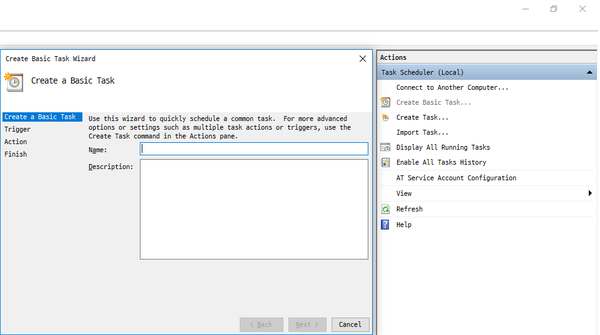
-
On the "Triggers" tab, you should pick "At startup".
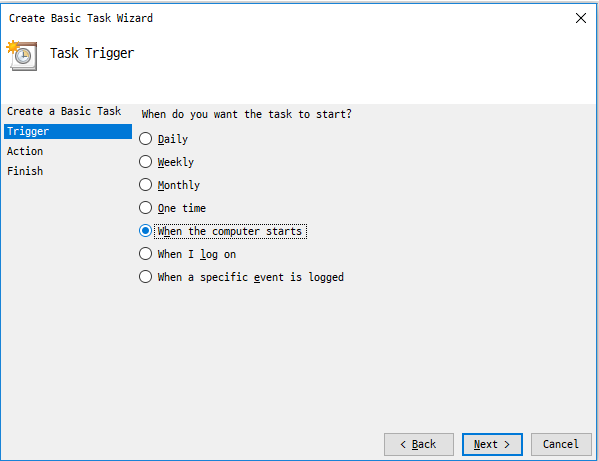
-
On the "Actions" tab, you should pick "Start a program".
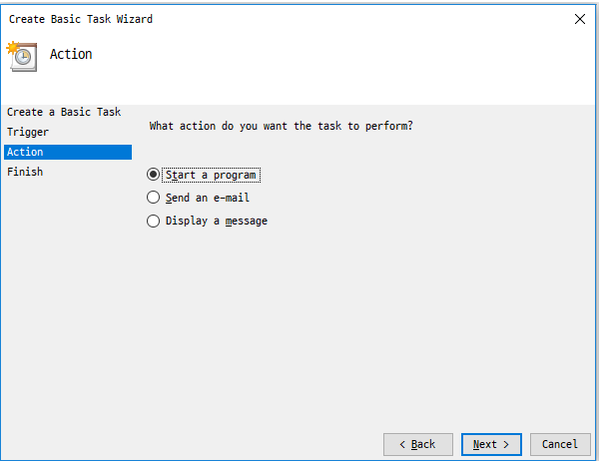
-
At 'Program/script', you should specify a path of Mudfish Launcher, normally it's
C:\Program Files (x86)\Mudfish Cloud VPN\mudrun.exe.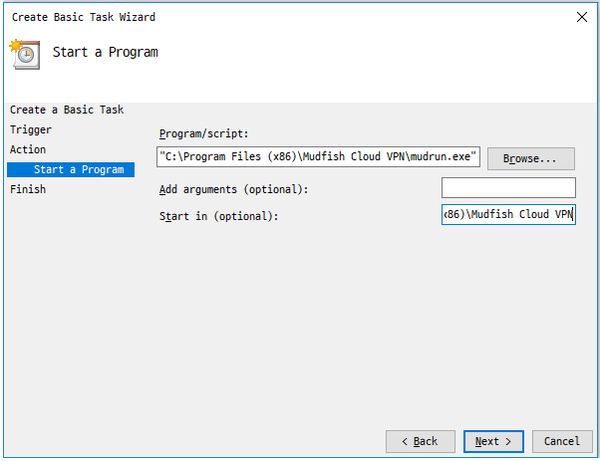
-
(Optional) At 'Add arguments', you can add
-B -u <your_id> -p <your_password>options to enable the auto login:-
-Boption means no opening the default browser. -
-u <your_id>option points your mudfish ID. -
-p <your_password>option options your mudfish password.
-
-
At "Start in" part, you can specify
C:\Program Files (x86)\Mudfish Cloud VPNpath.
-
After creating the task, select “Open the Properties dialog for this task when I click Finish”.
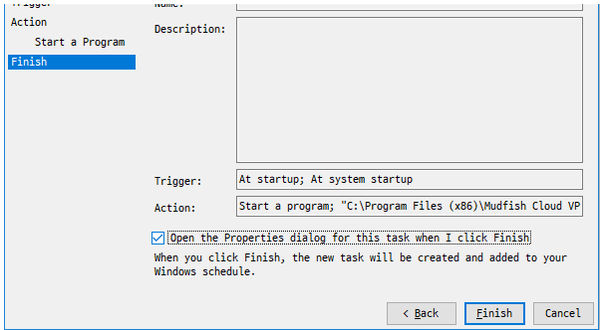
-
On the "General" tab, please make sure to mark "Run with highest privileges" because Mudfish Launcher requires the administrator privileges.

Browser shows "HTTP 500 Internal Server Error" at Mudfish Launcher?
This section is only for Mudfish Cloud VPN for Router. If you're an user of PC / Desktop, you can skip this section.
Are you under the network firewall? For mudfish it uses HTTPS connection to show UI interface for configuration. However sometimes if your network is under SSL inspection, this issue could happen.
For this case, you can try to use -S option
for Mudfish Launcher letting it to use HTTP rather than HTTPS connection.
To set it,
-
Moves "Mudfish Cloud VPN" menu from Start button.
-
Opens the property window of "Mudfish Launcher" icon.
-
Modify the command which found at "Target(T)" box that as default, the following value is set::
"C:\Program Files\Mudfish Cloud VPN\mudrun.exe"
-
Changes the command with
-Soption. For example, looks like below::"C:\Program Files\Mudfish Cloud VPN\mudrun.exe" -S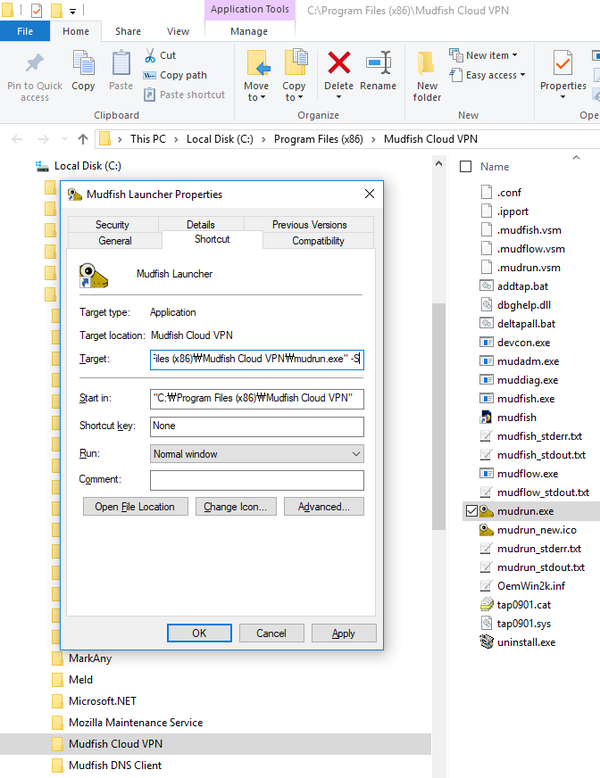
Legacy Microsoft Edge cannot open http://127.0.0.1:8282.
For the older Edge version that provides about:flags, open that page and
check “Allow localhost loopback”. Enable it if it is unchecked, save and retry.
Can Launcher always run as administrator?
Right-click the Mudfish Launcher shortcut, open “Properties → Compatibility”, and select “Run this program as an administrator”. Future launches through that shortcut will request administrator privileges.
Mudfish reports “Class not registered”.
Launcher may be unable to find the default browser, the browser may never have been configured, or malware may have damaged Windows registry entries.
Try these steps:
- If only Internet Explorer is installed, install Chrome or Firefox and set it as the default browser when prompted, then try again.
- Scan for malware.
- For the older Windows issue, see Microsoft's KB895339 troubleshooting reference.
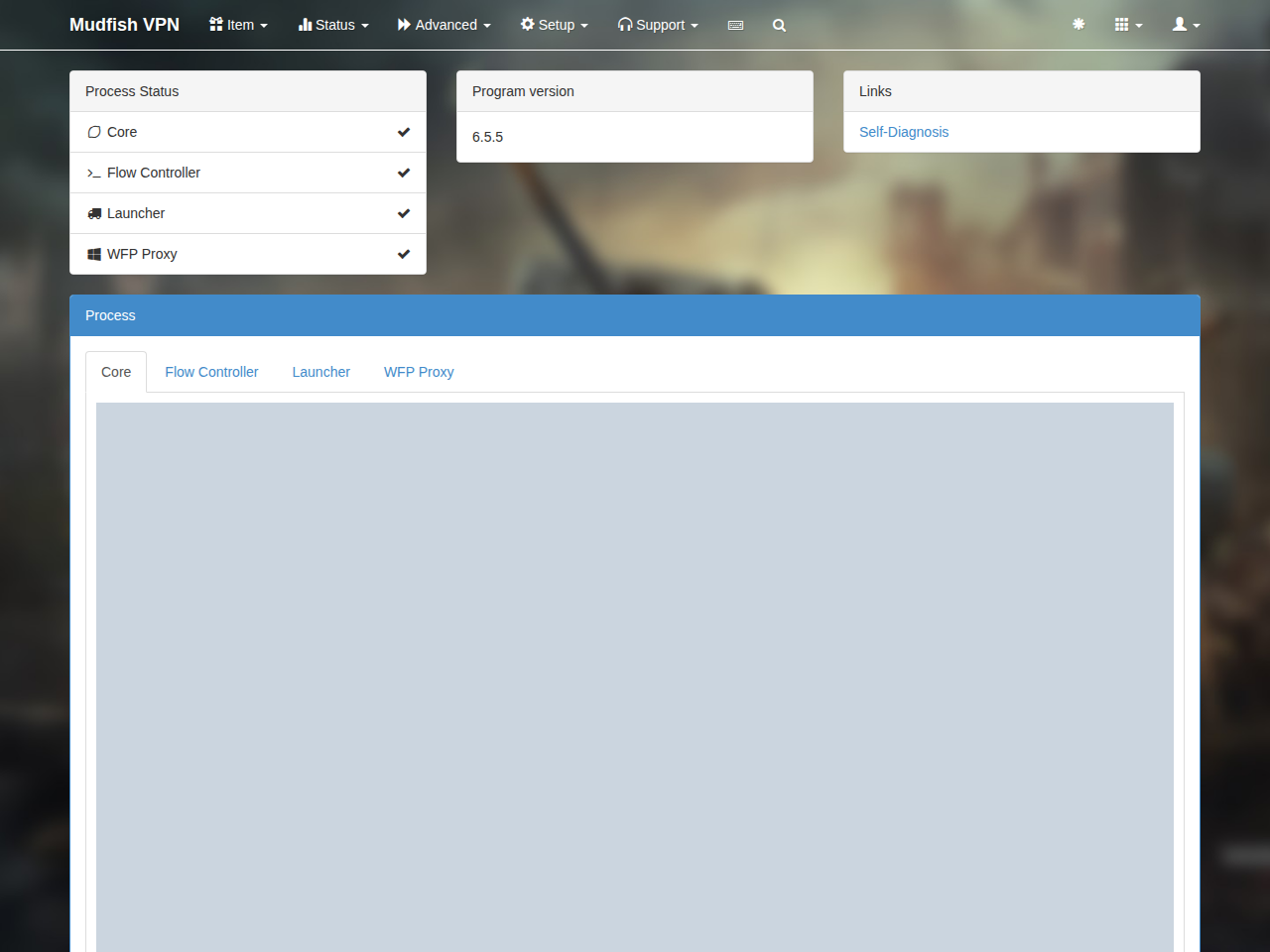
The dashboard shows an X for Process.
After signing in through Launcher, open Task Manager and check for all three:
mudfish.exemudflow.exemudrun.exe
If they are running, open “Status → Process” and look for WARN or ERROR messages in the Core log. Follow the linked error-code documentation.

Internet Explorer became slow after installing Mudfish.
Open “Control Panel → Internet Options → Connections → LAN settings”. Clear enabled automatic-detection or automatic-configuration-script settings, confirm the changes, and restart Internet Explorer.
How do I exit Mudfish?
Exit through the Mudfish icon in the Windows system tray. If processes remain,
open Task Manager and end mudfish.exe, mudflow.exe and mudrun.exe to stop
Mudfish completely.