Mudfish Master Server
This section describes about if you're encountering issues for Mudfish Master Server to connect.
Using -O option
Since Mudfish Cloud VPN v5.7.1 or above,
-Ooption is deprecated and removed.If you're using this option and the latest client version, you need to remove it to launch properly.
-
After clicking "Start" button of Windows, moves to or find "Mudfish Cloud VPN" menu.
-
Opens the property window of "Mudfish Launcher" icon by clicking the right mouse button on it.
-
Modify the command which found at "Target(T)" box that as default, the following value is set::
"C:\Program Files\Mudfish Cloud VPN\mudrun.exe" -
Changes the command with -O option. For example, looks like below::
"C:\Program Files\Mudfish Cloud VPN\mudrun.exe" -O -
As result, "Target(T)" would be like below:
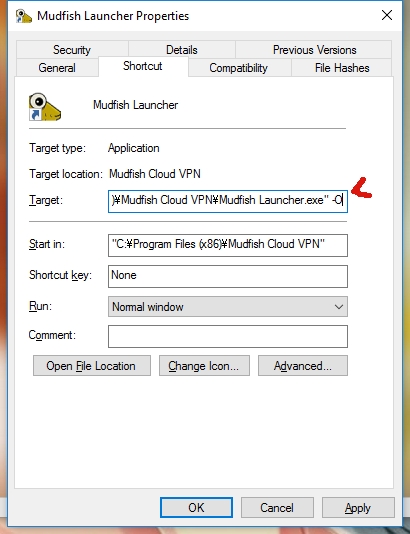
This screenshot shows an older launcher. The
-Ooption is only for versions before v5.7.1; remove it on v5.7.1 and later. -
-O option turns on a feature using IP and port of old master server.
Using -t option
If you're using Mudfish Cloud VPN v5.7.1 or above, you can simply enable
-toption by clicking 'Fire Icon' at the sign in menu.

-
At the property window of "Mudfish Launcher" icon, modify the command as follows:
"C:\Program Files\Mudfish Cloud VPN\mudrun.exe" -t
-
The
-toption uses HTTP-based communication with the master server by sending a simulated HTTP request.
Using HTTP-Proxy option
Since mudfish v5.2.0 or later, it provides HTTP-proxy feature to communicate with mudfish master server.
If the applicable options above do not work, you can try this option.
Do not use -O on v5.7.1 or later.
For details, please check Connecting Mudfish in China link.
Changing the MAC address
Some ISPs have been reported to block VPN connections based on a MAC address. Changing the address may help in these cases.
- If your computer connects through a router, consult the router's manual for its Internet-facing MAC address setting. The location varies by model, and some routers do not support changing it.
- If the Internet cable connects directly to your computer, find that network adapter and check its advanced driver settings for a MAC address option. Some drivers do not support this setting.
See Changing Mac Address for the Windows adapter example.
A reported example
A user named never38k, using China Telecom in Shanghai, reported that both UDP and TCP VPN connections stopped working while other Internet services continued to work. Changing the ISP-provided router's MAC address restored the VPN connection, but it was blocked again about an hour later.
The user traced the recurring block to a Korean 070 Internet telephone on the network. After changing the MAC address again and switching off that telephone, the problem stopped. This is a user's reported experience, rather than a diagnosis that applies to every blocked connection.